> For the complete documentation index, see [llms.txt](https://help.exporteo.solvenium.com/llms.txt). Markdown versions of documentation pages are available by appending `.md` to page URLs; this page is available as [Markdown](https://help.exporteo.solvenium.com/post-processing.md).
# Post-processing
Exporteo allows adding the order tag or updating the order note field, order metafield, as well as the customer metafield after a successful order export.
{% hint style="info" %}
You can use Liquid formulas in all fields described in this section.
{% endhint %}
### Tag order
Check the option *Tag exported orders with* and provide a tag to be added. Previous tags will not be overwritten.
Tag an order after a successful export
To add more tags, separate them with commas:
Add multiple order tags
You can use Liquid with variables related to an order to add tags conditionally:
Tag orders conditionally
### Order note
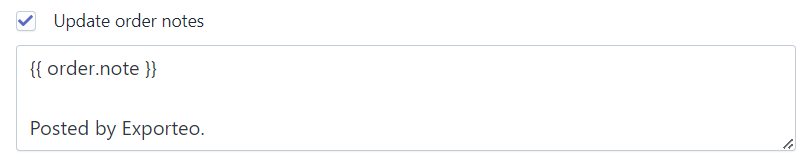
Unlike tags, Exporteo overwrites the content of the order note field. To keep its previous content and add new information, use the variable `{{ order.note }}`
Update order notes
### Order metafield
Exporteo allows updating the order metafield after a successful export. This can be particularly useful when an order is transmitted via API, and there is a need to save the order ID created in the supplier's system.
Update order metafield
Available only for the HTTP destination channel.
### Customer metafield
Exporteo enables you to update the order metafield after a successful export. You can use this option when you need to save the customer's ID from the supplier's system.
Update customer metafield
Available only for the HTTP destination channel. Requires adding `write_customers` scope to Exporteo.
### Save the value of a field from the API response
You can save the value of a specific field from the API response as a tag, order note, order metafield, or customer metafield. To do that use a Liquid formula. The entire response is stored in the `response` object. To fetch the value from a specific field use a dot notation, e.g.: `{{ response.customer.customer_id }}`
{% code title="API sample response" %}
```json
{
"supplier_id": "12345",
"order_id": "67890",
"customer": {
"customer_id": "09876"
},
"status": "Confirmed",
"items": [
{
"product_id": "ABC123",
"name": "Wireless Mouse",
"quantity": 2,
"price_per_unit": 25.99,
"total_price": 51.98
},
{
"product_id": "XYZ456",
"name": "Keyboard",
"quantity": 1,
"price_per_unit": 45.99,
"total_price": 45.99
}
],
"shipping": {
"method": "Standard",
"estimated_delivery_date": "2024-12-30"
},
"total_order_price": 97.97,
"currency": "USD"
}
```
{% endcode %}